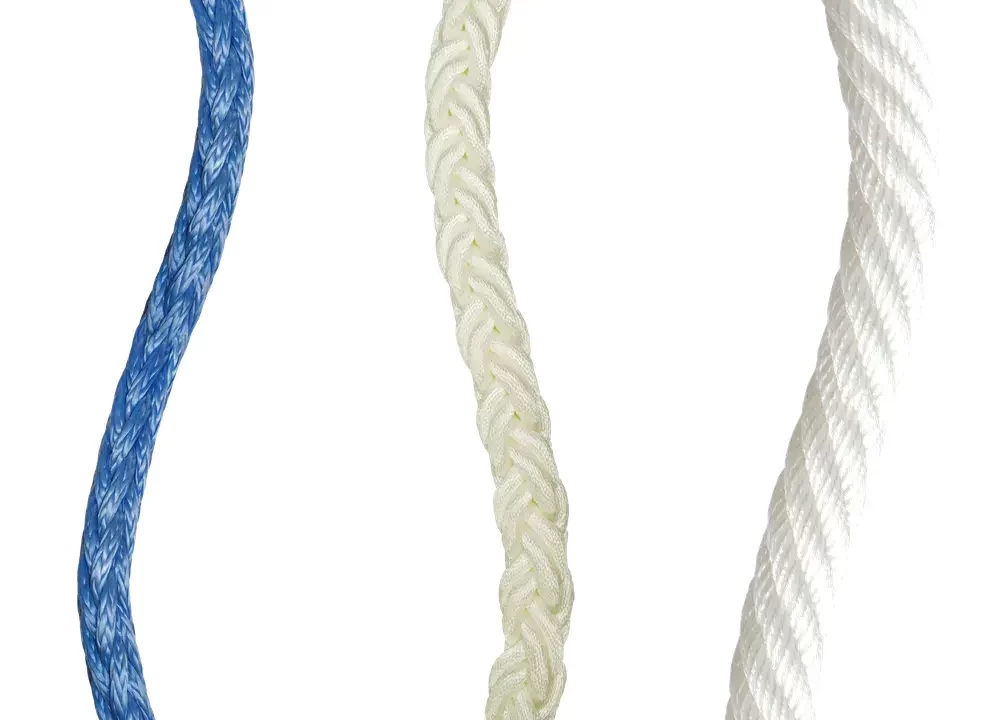
Two ropes of the same diameter can behave completely differently depending on the fibre. One floats and barely stretches; another sinks and stretches like a spring. Knowing the three main fibres helps you choose rope that lasts and performs safely.
At a glance
| Property | HMPE (UHMWPE) | Polyester | Nylon (polyamide) |
|---|---|---|---|
| Strength for its weight | Highest | Good | Good |
| Elongation at break | About 3–4% | About 10–18% | About 14–28% |
| Specific gravity | 0.97 (floats) | 1.38 (sinks) | 1.14 (sinks) |
| Melting point | 140–145°C | 255–265°C | 215–220°C |
| UV resistance | Excellent | Excellent | Good |
| Abrasion resistance | Very good | Excellent | Excellent |
| Wet strength | Same as dry | Same as dry | Lower when wet |
| Creep under constant load | Yes, at high loads | Hardly measurable | Slight |
| Typical cost | Highest | Medium | Medium |
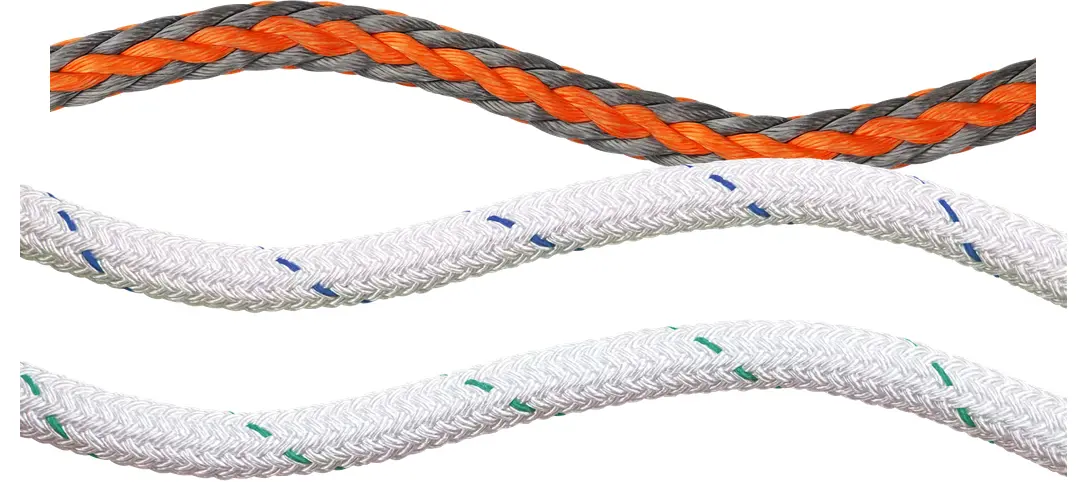
HMPE: maximum strength, minimum weight
HMPE (Dyneema®, Spectra® and Ralon™ are well-known fibres) is the strongest rope fibre by weight. A HOPEX™ HMPE rope is stronger than steel wire of the same size, yet weighs about one-seventh as much and floats.
- Best for: Ship mooring lines, towing, offshore, heavy-lift slings, soft shackles and racing yacht halyards.
- Watch out for: Low melting point, so keep it away from heat and friction on winch drums. It also creeps under long, constant high loads.
Polyester: the all-rounder
Polyester balances strength, low stretch and outstanding resistance to UV and abrasion. It keeps its strength wet or dry and handles well.
- Best for: Yacht sheets and halyards, dock lines, mooring lines, webbing slings and general marine use.
- Watch out for: It sinks, and it is heavier than HMPE or polypropylene.
Nylon: the shock absorber
Nylon stretches more than any other common rope fibre, so it absorbs sudden loads from swell, wash and towing jerks.
- Best for: Anchor lines, dock lines in exposed berths, mooring tails, towing lines and bungee or shock lines.
- Watch out for: It loses some strength when wet, and too much stretch makes it unsuitable for halyards and lifting.
Which should you choose?
- Need the lightest, strongest line? HMPE.
- Need durability in sun and salt with low stretch? Polyester.
- Need to soak up shock loads? Nylon.
- Need a rope that floats and costs less? Look at polypropylene or polyolefin blends such as Tough-Mix.
Many high-performance ropes combine fibres, such as an HMPE core with a polyester cover, to get strength inside and grip and abrasion resistance outside.
Tell us your application and load, and our team will recommend the right rope.